
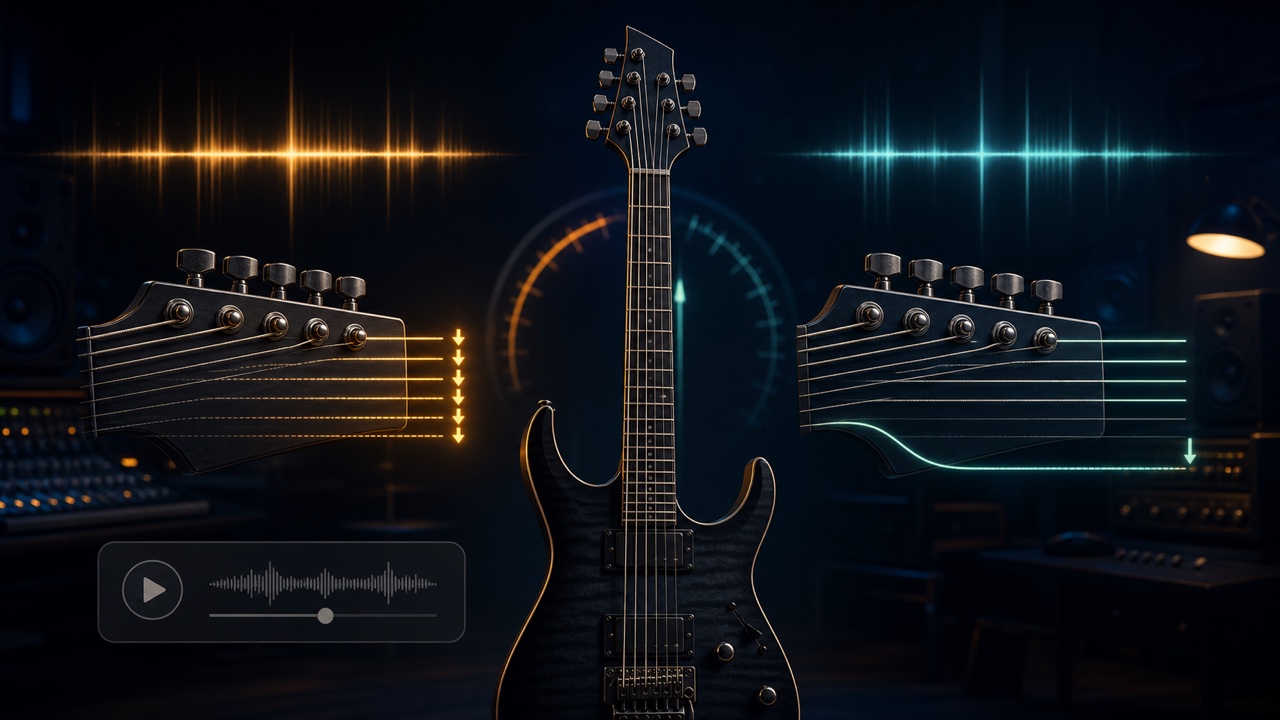
When you play along with a guitar or bass track, every note may be a half step off even though you are using the correct fret positions, or only a riff on the lowest string may sound wrong. The original may have been played in a nonstandard tuning, such as half-step-down or Drop D.
Start by checking the tuning of the original track separately from the current tuning of your instrument.
Standard, Half-Step-Down, and Drop D Tuning
- Standard: On guitar, E, A, D, G, B, E from the lowest string to the highest
- Half-step-down: Every string is tuned one half step below standard
- Drop D: Only the sixth string is lowered from E to D
Half-step-down tuning keeps the intervals between the strings the same as standard tuning, while Drop D changes the relationship between the sixth and fifth strings. Therefore, the two tunings cannot be handled in the same way.
Use Open Strings and Low Riffs to Identify the Tuning
Listen for sustained low notes or sounds that resemble open strings, then play the same notes on your instrument. You can also use “Find the BPM and Key” to check possible keys, but a song’s key and a guitar’s tuning are not the same information.
Consider the lowest note, chord shapes, and use of open strings together. Some older recordings also deviate slightly from standard pitch.
Tune Your Instrument to Match the Original
If you want to reproduce the original fingerings and the sound of its open strings, the standard approach is to tune your instrument the same way as the recording. Use a tuner, and check every string again after changing the tuning.
Lowering the tuning substantially makes the strings looser and can make the pitch and playing feel less stable. If you may need heavier strings, a neck adjustment, or intonation adjustment, do not force the change; consult a music store or repair technician.
You Can Raise a Half-Step-Down Track for Practice
If the original is tuned down a half step and you want to keep your instrument in standard tuning while playing the same shapes, raising the entire recording by one half step will match the pitches.
Set “Change Pitch” to +1 semitone. The song’s tempo and length will not change. Because this also alters the character of the vocals and drums, use it as a practice track.
Changing the Entire Track’s Pitch Cannot Reproduce Drop D
In Drop D, only the sixth string is lowered by a whole step while the other strings remain in standard tuning. Moving the entire recording by two semitones changes the other instruments and every string, so it does not preserve the same fingering relationships.
To practice low power chords and riffs that use the open sixth string as they appear in the original, lower the sixth string to D or rearrange the fingering for standard tuning.
Listen to Each Instrument’s Role in Alternate Tunings
The guitar and bass may not use the same tuning. Use the “Stem Splitter” to separate the stems so you can focus on low riffs and bass lines more easily.
Because stem separation can introduce errors, do not reach a conclusion from the lowest note alone. Check several phrases.
Build a Practice Track Step by Step
- Identify the original track’s tuning and choose the tuning for your instrument
- If necessary, change the original track’s pitch in semitone increments
- For a fast song, lower the tempo separately from the pitch
- Extract a difficult section with a little extra time before and after it
- Finally, check your playing at the original speed and pitch
For the difference between changing pitch and changing tempo, see “The Difference Between Changing Key and Changing Tempo”. For creating practice sections, also see “How to Create Practice Tracks for Your Instrument”.
Use Modified Audio Only for Personal Practice
Commercial recordings remain subject to the rights in the original audio even after you change the pitch, change the tempo, or extract a section. Use modified tracks only for personal practice and analysis, and do not publish or distribute them without permission.