
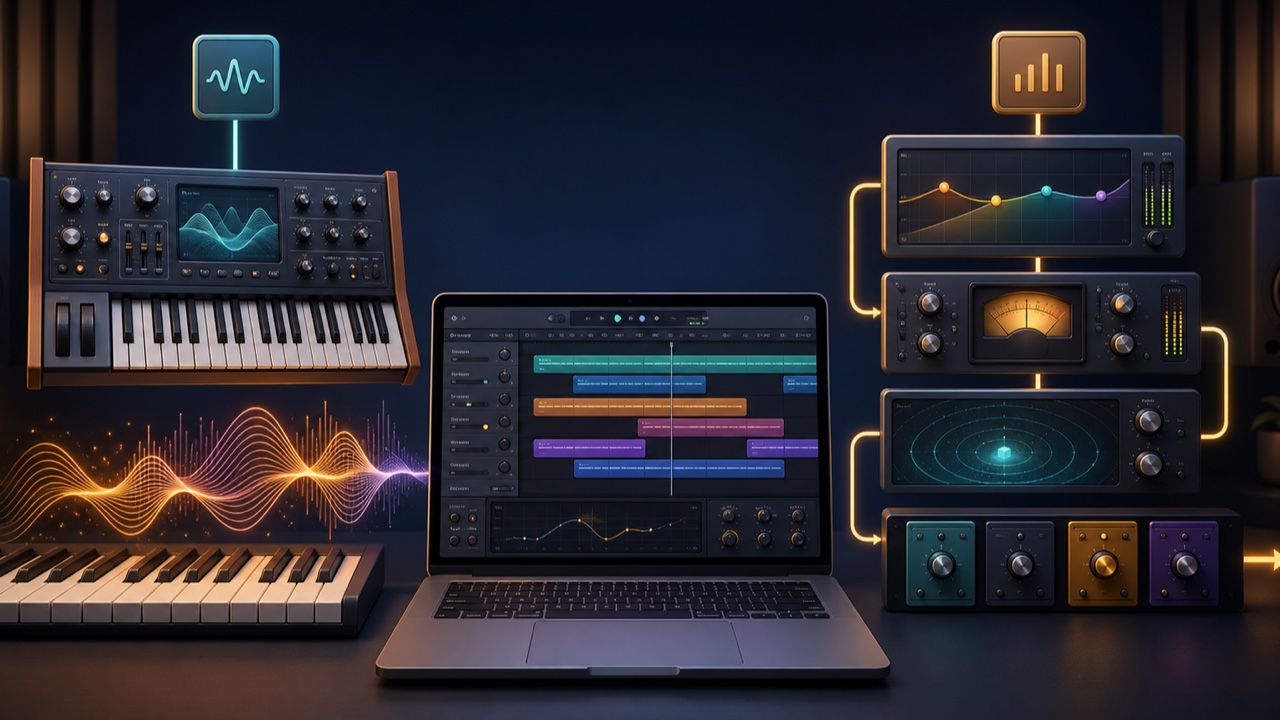
When you begin producing music, you frequently encounter the terms “software instrument,” “plug-in,” and “effect.” They are used in similar contexts, but their meanings cover slightly different areas.
Plug-in is the general term for software that adds functionality to a DAW. This category includes software instruments that generate sound and effects that process sound.
A Plug-in Adds a Function to a DAW
A plug-in is software that adds instruments, effects, meters, and other functions to a DAW. Some are included with the DAW, while others are products you install separately.
Plug-in formats include Audio Units, VST, and AAX, and compatibility varies by DAW and operating system. Before buying one, make sure its format works in your production environment.
A Software Instrument Turns MIDI into Sound
A software instrument is a plug-in that receives MIDI data and produces sounds such as piano, drums, synths, or strings. It is also called an instrument plug-in.
Examples include synthesizers that generate sound electronically, samplers that load and play recorded material, and instruments that reproduce acoustic instruments. You can dramatically change the tone of the same MIDI data simply by replacing the instrument.
An Effect Processes Its Input Sound
An effect plug-in applies processing to a sound that is already playing. An EQ adjusts frequency ranges, a compressor controls level differences, and reverb and delay create a sense of space.
An effect by itself generally cannot produce an instrument sound from a MIDI note. It receives audio from a software instrument or a recording and alters that sound.
The Order of Insert Effects
When you place several effects on a track’s insert slots, the audio is processed from top to bottom. For example, placing a compressor after an EQ can produce a different result from placing the EQ after the compressor.
Do not begin by loading many plug-ins. Decide what you need to fix and add them one at a time. Toggle each one on and off, match the listening level, and evaluate what it actually changes.
A Simple Way to Tell Software Instruments and Effects Apart
- Produces an instrument sound when it receives MIDI: software instrument
- Changes a sound it receives: effect
- Any functionality added to a DAW: plug-in
Beginners Should Start with the Included Plug-ins
Before buying more commercial plug-ins, try the instruments, EQ, compressor, and reverb included with your DAW. Once you understand their basic roles, it becomes easier to decide why you might need a new product.