
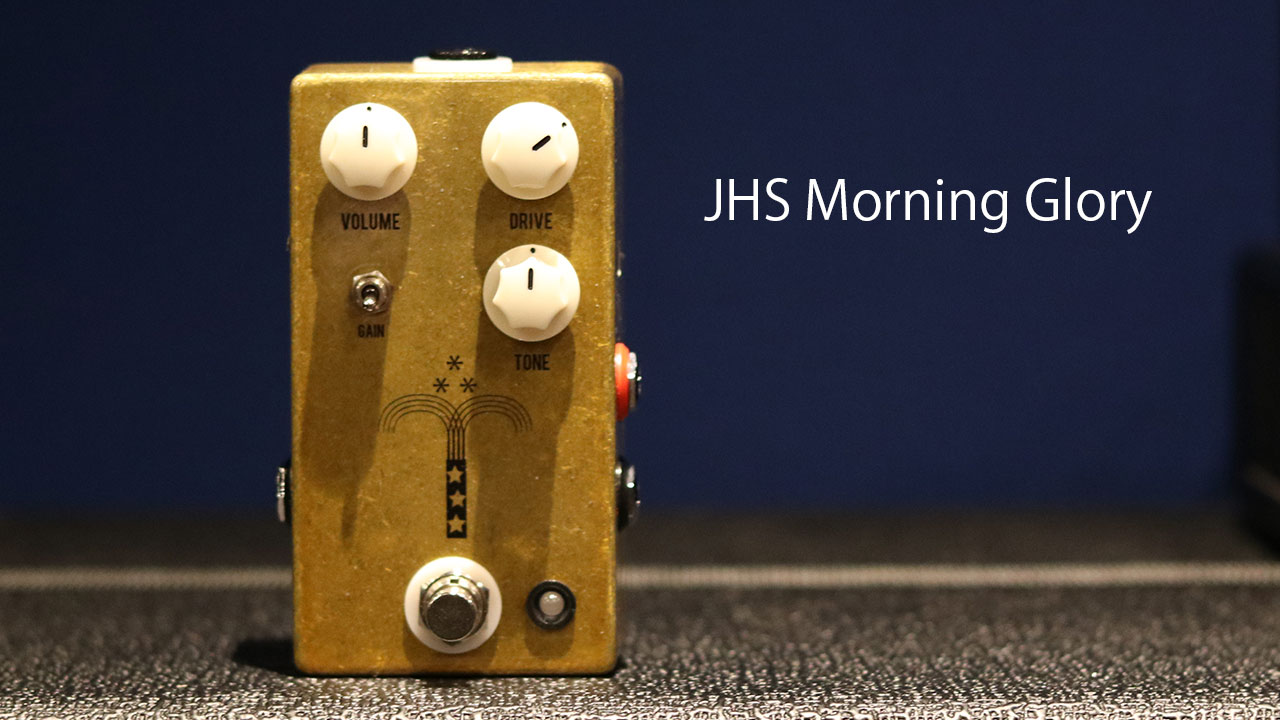
I use the JHS Morning Glory as my main overdrive pedal.
Its Marshall-like, amp-style response feels great to play and works across many situations.
The Amp-Like Morning Glory Overdrive
This is the Morning Glory I use.

My main criteria for an overdrive are:
The Morning Glory met all three and immediately became a primary pedal.
The following article explains my criteria in more detail.

Here are the pedal’s main characteristics and what I like about it.
Excellent Picking Dynamics
The Morning Glory responds clearly to picking strength. With a good crunch setting, strong playing breaks up while gentle playing becomes clean.
It takes some control to use well, but that amp-like response becomes addictive.
Clear Note Separation
The Morning Glory also keeps individual notes distinct.
Watch this video, recorded with a PRS Modern Eagle and a Marshall JCM 900 in a rehearsal studio.
The notes within each chord remain easy to distinguish.
A Broad Range of Useful Sounds
Every overdrive has a range where its controls sound best.
The number of controls matters less than how much of their range produces usable sounds.
With the Morning Glory, maximum gain mostly feels loud, but settings from roughly 11 to 2 o’clock sound excellent.
Around 11 o’clock produces moderate crunch; near 2 o’clock creates a more powerful overdrive.
It is not intended for extreme distortion, but it works well as a booster that adds body and brightness to another pedal.
The pedal also has a gain-boost switch. In this video I enabled it, set Gain to maximum, Volume and Tone to noon, and played palm-muted parts.
For this much gain, however, JHS’s Angry Charlie may be the better choice.
Conclusion
The Morning Glory works as a main overdrive or booster and is a versatile pedal to own.
I recommend trying it if you enjoy controlling drive through your playing dynamics.