
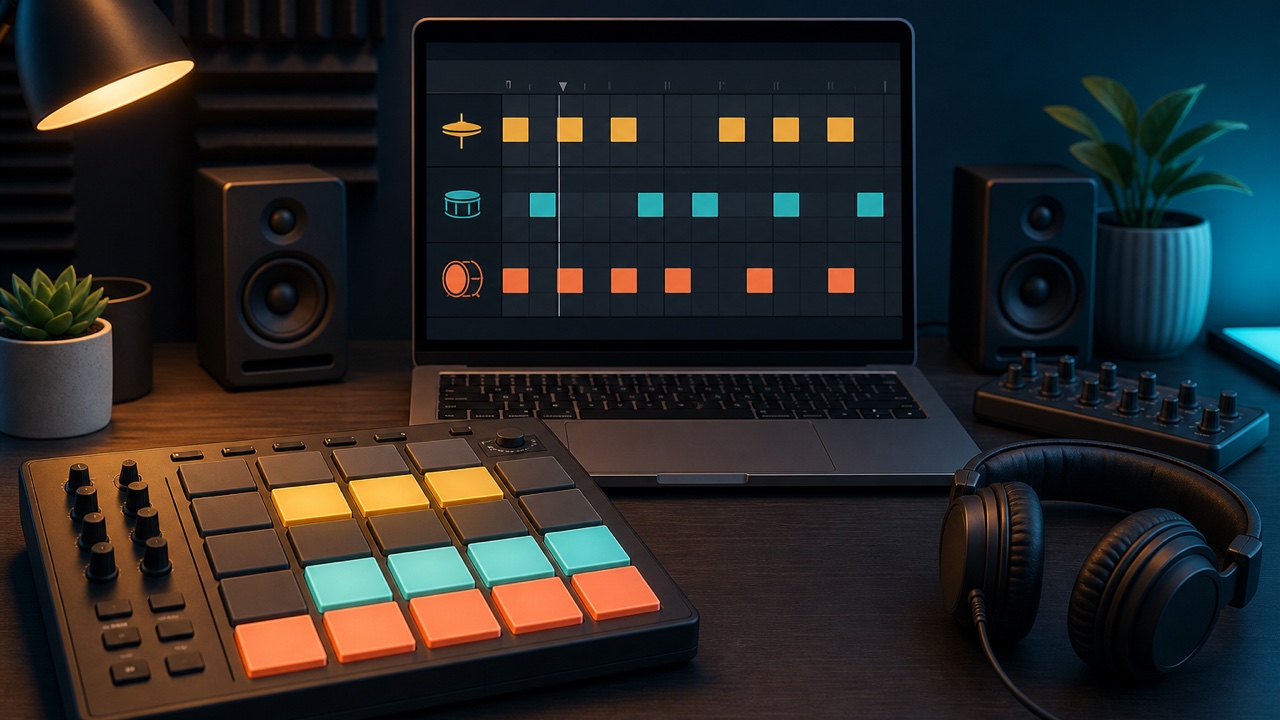
Programming drums is an important part of building the foundation of a song in a DAW. Instead of creating a complex pattern immediately, start with only a kick drum, snare drum, and hi-hat. Building a basic beat with these three parts makes each role easier to understand.
First, Review How to Count 4/4 Time
In 4/4 time, count each measure as “1, 2, 3, 4.” Set the DAW grid to eighth notes or sixteenth notes, then enter notes while listening to the metronome.
Start with only one measure and check it in loop playback. Before creating a long section, make a short pattern that feels good when repeated.
Use the Kick to Establish the Low-End Center of Gravity
The kick establishes the beat and the low-end center of gravity. Placing it on beats one and three creates a simple starting beat. In dance music, a four-on-the-floor pattern with kicks on beats one, two, three, and four is also fundamental.
When adding bass, check where it plays at the same time as the kick. Sustained overlapping low frequencies can become muddy, so adjust their duration and placement as well.
Use the Snare to Mark the Beat
Pop and rock commonly place the snare on beats two and four. Play only the kick and snare and check whether they create a clear framework you could clap along with.
Adding quieter ghost notes between the regular snare hits can create a more detailed groove. Keep them quieter than the main snare hits so they do not stand out.
Use the Hi-Hat to Create Detailed Motion
The hi-hat plays eighth notes or sixteenth notes to create a sense of speed and forward motion. Repeating every hit at the same strength can sound mechanical, so vary the velocity, such as by making the beginning of each beat slightly stronger.
At a section transition, adding an open hi-hat or crash cymbal can signal the next development in the song.
Do Not Overuse Quantization
Quantization aligns displaced timing to the grid. It is useful for establishing the basic positions, but aligning everything perfectly can remove the natural movement of a performance.
One approach is to align the kick and main snare hits while leaving slight timing variation in the hi-hat and ghost notes. Adjust the amount to suit the genre and texture you want.
Add a Fill in the Fourth or Eighth Measure
A fill is a short variation that signals a section transition. Even a few faster snare or tom hits during only the final beat can be enough.
Too many fills can destabilize the basic beat, so begin with one every four or eight measures. Placing a kick or crash on beat one of the following measure makes the transition clear.
A Beginner-Friendly Workflow
- Build the framework with the kick and snare
- Program eighth notes on the hi-hat
- Add accents with velocity
- Check the low end with the bass
- Add a fill in the fourth or eighth measure
In drum programming, the role and timing of each part matter more than the number of sounds. Complete a simple pattern first, then add only the sounds the song needs.